Journey to the northern point of South America

The best part about traveling is talking with other travelers and learning about amazing places I had no plans of visiting. One of these places is Punta Gallinas, the most northern point of South America, where the desert meets the water. A quick search online gives the most surreal views. Being there myself, I can say that it is like being on another planet.

View from the car
Made it to the most northern point!

Getting there however is the challenge. A 3 day tour with a tour company will cost at least 200$ and go up to almost double. After talking with a few people, I had a contact. He provided the transportation for the 3 days, accommodation and food would be separate. This option was much cheaper and I found myself booking it soon after. Along the way, I had met some other backpackers who were quick to join as well.

Most of the trip was driving in the desert, stopping along the way at certain view points and beaches. However, the drive itself is just as much a part of the attraction, sometimes having the feeling of being in a video game with screens all around as we looked out the window. Those moments were quickly short lived as we drove by a checkpoint guarded by the army since it is very close to the Venezuelan border and families living in what truly seemed like the middle of nowhere.

Walking through the cactus field after watching the sunset
Way to the river to take a boat, making the journey back a much shorter drive

A trip to the jungle

My last stop in Peru, Iquitos is the city in the jungle, only accessible by plane or boat. For most, it is the place for jungle tours to see the various animals. However, Iquitos was not in the itinerary previously so I had already done a jungle tour near Cusco. Iquitos was the place for another experience: ayahuasca.

Since I arrived in Peru, I’d been hearing more and more talk about ayahuasca, a spiritual ceremony that seemed to work wonders for most people, no matter how much the experience differed. Some found meaning and direction in their life, others overcame a drug addiction. I was highly intrigued by the wonders it did but was also a bit skeptical to try it. For one, the user tends to vomit or have diarrhea, a cleaning of the body to add to the cleaning of the soul that comes with the ceremony. Also, the plant is a hallucinogenic, hence the importance of shamans to help guide the hallucinations. For over a month and until I was in Iquitos, I was thinking whether or not to try it. I met a friend who told me in detail his experience, everything he knew that finally convinced me.

One of my guides was a native of iquitos and arranged a meeting for me with shipibo vision, a family who did ayahuasca ceremonies at their jungle retreat an hour outside of the city. Soon, I was cramped in a local bus with them headed to the retreat for 2 ceremonies, a 4 day trip. The parents were the shamans of the ceremony, with the 2 eldest sons attending as well since they were training to become shamans.

Once arrived there, I was asked about my lingering cough that I had gotten from the Huayhuash trek. The father immediately went out to their garden to pick some leaves to make me tea. Afterward, it seemed I was coughing more and the next 2 days, got a different tea made with another plant. The mother also gave me a massage with vaporub near the chest area. These seemed to do the trick as my cough had ended once I was headed back to the city. As for the ceremonies, I was going to have them on the 1st and 3rd nights, leaving a day in between to rest. Before each ceremony, I was given a flower bath, a variety of leaves picked from the jungle and mashed with the river water, poured over me, little by little. There was special cabin just for ceremonies, in the dark jungle where the nocturnal insects and animals seemed to be wide awake, making the jungle come alive. For the whole duration, the shamans were singing and chanting, allowing them to guide the hallucinations. They are extremely personal and only felt by the user and the shaman, an experience that is highly emotional as well.  On the day off, I did a jungle walk, where they showed me important plants, both medicinally and spiritually. Some were used to treat cancers, another for diabetes. It was interesting to learn about their treatment for so many modern diseases. The treatment of diabetes was by a specific tree’s bark, its bitterness to counter the sugar imbalance. The last day, before heading into the city, I was given one last flower bath, this time with actual flowers for protection for the rest of my trip.

Other than ayahuasca, I also visited a butterfly farm that turned into an animal orphanage located across the river. Gudrun, a native of Austria, had started the butterfly farm as a way to educate locals on the life cycle of caterpillars and butterflies. People started dropping off endangered animals at her door which is how the animal orphanage started. I went with an American and Australian so we had an English tour, given by Gudrun herself. From the tour, it was easy to see how passionate she is about the work she does as well as the love and compassion she has for the animals, each having been brought to her because of difficult circumstances.

From Iquitos, I crossed the Amazon river by fast boat, a 10hr boat ride, to arrive in Leticia, Colombia, ready for the next adventure. Arriving in Leticia and having already seen it from the Peruvian side, I took a flight the next day to Medellin.

Trekking, trekking and more trekking

During my trip, I was told about a trekking town north of Lima, Huaraz. I love hiking so I decided to check it out. The town is completely surrounded by mountains and everywhere, there are agencies selling tours. The 1st trek I did there was a day hike to the popular Laguna 69. It was a Saturday and Easter weekend, meaning the place would be packed with locals and tourists alike, with everywhere also raising the prices for the tour. I found a great tour company, Caleb Expeditions. We started early in the morning, hiking at a good pace to make it to the top before all the crowds arrived. The view was breathtaking. The colour of the water was so blue it barely looked real and the clouds cleared up to show the glaciers in the background.

I decided to book again through them, this time for an 8 day trek. A search online shows this trek, Huayhuash, to be one of the nicest in the world. We were 2 groups, 1 doing the 6 day option and the other, the 8 day trek, both taking the same way before splitting off on the 6th day. The 1st day was spent in the van so it’s only 7 days of hiking…how wrong was I to think it wouldn’t be so hard. The 2nd day was a full 8hrs of hiking. Once again, mother nature decided to remind (punish) me for skipping part of the Canadian winter and I woke up to snow completely covering the ground and our tents.We did another full day hike, this time in the melting snow. It was only the 3rd day and all of our boots were completely soaked through and would be for the rest of the trek. A few people didn’t wear sunglasses that day and woke up to painful and red eyes on the 4th day. My group took a consensus to rest that day so we stayed at the camp site, a great opportunity to dry out our boots. The other group continued on, losing a few members and a guide who turned around to head back to Huaraz. We were right near a river and 1 guy from my group had fishing line so the activity for the day was fishing. We made some makeshift rods, tying the fishing line to hiking poles. Somehow, all of us were unsuccessful in catching any fish. Lucky for us, our guide Santos, caught enough fish for every one and we had fresh fish for dinner.

After a day of rest, we continued on, happy about having dry boots, which for me, barely lasted the morning. After about an hour of hiking, there was a river which we had to build our own steps to cross it. Me being my clumsy self, I slipped on one of the rocks and fell knee-deep into the cold river, sadly dragging the guide in with me. So much for dry boots! The 5th, 6th and 7th day were all full day hikes, having to make up for the lost day.

The highest point we reached during the hike was at 5200m and quite a treacherous hike both up and down the mountain. While making our way up, we heard thunder and a light drizzle started. We decided to speed up a bit, hoping to beat the oncoming storm. That was not the case. Halfway up, it started to snow heavily and it was extremely windy. There was no view and once everyone made it to the top, we headed back down right away to face the snowstorm. We were all so cold and our clothes were completely soaked by the time we got to the campsite.

We had finally made it to the last day of the hike, which was mostly downhill or flat. The sun was out, the best weather we’d had, able to enjoy the scenery and a great end to the hike.We were all happy to get back to civilization for a much needed shower and clean clothes.

24hrs in Lima

I arrived in Lima late at night, ready to leave already since I am not a fan of the big city. All my bus rides from La Paz up to Lima have been with Peru Hop, a tourist bus service. The leg from Arequipa to Lima was with the same guides who kindly agreed to bring us to eat the best ceviche at a place unknown to tourists for lunch. It was definitely one of the best ceviches I’ve had during my trip!

After lunch, we headed to the beach in the other affluent neighbourhood of Lima. It was Easter weekend and the streets were full of families. The main square had so many vendors with balloons, I felt a bit like was in Disneyland. We enjoyed the beautiful sunset at the beach before heading to another delicious restaurant to try anticuchos, translation: cow heart, our guide’s favourite dish so we had to have some. The cow heart is cut into medallion sized pieces, about 2cm thick and put on a skewer to grill. The texture of the meat is unlike anything I’ve had because it is all muscle and the flavoring was delicious. Definitely worth trying! All of us who tried it thoroughly enjoyed it.

Lima is known as the food capital of South America, with many Michelin star restaurants all over the city and this small food tour was a great way to spend the day in Lima before passing out in the bus headed to the trekking town of Huaraz.


Paracas and the poor man’s Galapagos

Upon my arrival at the small town of Paracas, I found out it was having a blackout, apparently because everyone had turned on their tvs to watch the soccer game. Once the electricity had come back on, I went out looking for a place to eat. Finding nothing open, I opted for the classic college meal of cup noodles. The chicken tasted great but the undescriptive “meat flavoured” one was gross. I ended up feeding the noodles to the hostel cat who loved me during my 1 day stay there.

The next day was the tour to the Ballestas Island, also known as the poor man’s Galapagos because of the variety of animals that can be observed on the island and costing a merr fraction of the price to visit the real Galapagos. The tour is done by boat and you stay I  the bot the whole time. About 10mins into the boat ride, our boat stopped working and we had to wait for another boat to come, the captain looking suspiciously like a pirate because of the bandana on his face, rescue us. In the middle of the water, we hopped over to the next boat and continued on our way…only to have another problem with our boat again. After what felt like 20mins, another boat with passengers passed by. Their captain hopped onto our boat and magically, managed to fix the problem. We were finally on our way. The island is inhabitated by thousands of birds, everywhere was completely covered with bird poop, 5 cute penguins and many families of seals. Like the cost, the variety of species of animals is a mere fraction of what there is on the Galapagos but still a nice tour to do.

After the tour, I sat on the beach to soak in some sun before visiting the Paracas National reserve, preserved because of its unique environment with a desert on the coast of the ocean. The stark contrast between the 2 made for quite a scenery.

The beautiful natural scenery was well appreciated before heading to the hectic capital of Peru.


Nasca and Huacachina

From Arequipa, I was headed to Huacachina, an oasis in the middle of the desert; finally some sun and heat. On the way there is a stop in Nasca, well-known for its lines, massive images in the ground drawn thousands of years ago that can only be viewed completely from above. The full tour is a half hour flight to see them in all their glory but I opted to do the quick stop at a viewing tower where 2 of the drawings can be seen before heading off.

A few kilometers outside Huacachina is a pisco vineyard and production place. I took a short tour, learning how Peru’s national alcohol is made then sampling 7 varieties of it.

Back in Huacachina, it was time to try my hand at sandboarding down the many dunes. This included a ride in a dune buggy up and down the hills which felt more like a roller coaster ride. Sandboarding is definitely very different from snowboarding, especially since the sand creates so much friction on the bottom of the board, which had to be waxed after every ride. Peruvians are creative people and the waxing of the board could be done very simply by ourselves. Our driver handed each of us a piece from a candle stick and we would use that to wax our boards. I am still not sure how effective it was but it’s very funny to see.

After the desert, it calls for a trip to the ocean town of Paracas.


Arequipa stupidities

I was told Arequipa is the 2nd biggest city in Peru after Lima so I expected at the very least a decent sized city. I mostly stayed in the center and didn’t get to see the outskirts but it reminded me of Cusco, with a beautiful plaza in the center and a very safe place to walk around alone.

The activity to do there is a hike in the colca canyon, the 2nd deepest canyon in the world. The 2 day trek started with a view point along the way to see condors flying above before the full day trek into the bottom of the canyon. It was all downhill and made for an easy but long first day. Along the way, the trail gives beautiful views of the surrounding mountains and active volcanoes, one of them even had smoke coming out. A good night’s sleep was well needed for the next day’s hike back up. The trail is much more direct going up and with an early start to the day, I was able to hike while enjoying the sunrise.

At the top, I came across some friends I had met on the bus to Arequipa from Cusco. They wanted to hike up one of the volcanoes, the highest one specifically, which was just above 6000m or 20 000ft. I was planning to do a hike up a volcano as well and decided to join them for this exciting adventure. The problem, which at the time seemed like a good idea because I was full of adrenaline from the hike up the canyon, was that they were leaving that night at 10pm for a 3hr ride to the start of the trail…we were going to start the hike at 1am! We were also joined by a German girl who they had met previously. We invited others, who were smart enough to say we were crazy and refused to join in. Normally, this hike is done in 2 days but the 2 Americans and the German had a bus to catch so we did it in 1 day, hence the late, or early, start in the middle of the night.

Made it to the top

Since the volcano is so high, we were nicely equipped with many layers, ski gloves, snow pants and the most exciting, crampons and an ice pick. I got quite a few looks and smiles walking down city streets with an ice pick in hand! Running on no sleep, we started the adventure with a very very quiet ride to the start of the trail and the hiking began at 5000m in the pitch black, the only light coming from our head lamps. Nine hours of dreadful uphill hiking later, we finally arrived to the top, cold, hungry, exhausted but so happy and relieved. This resulted in an interesting hike down, especially the last part where we hike among lots of big rocks. We were so over exhausted that we started hallucinating and seeing things among the rocks including houses, faces and Shrek?!?! Yet, we decided not to go straight to bed once back in the city. Our last “meal” was some bread and tea for breakfast at 3am so we were more desperate for food. After a shared roast chicken, an ice cream, tacos, another ice cream and a pizza later, we were finally hitting the sack at 11pm meaning we had stayed awake for about 42hrs with 2 hikes under our belts.

We were the talk of the town back at the hostel. Apparently everybody had heard about these crazy Americans, German and Canadian hiking up a volcano on no sleep after having hiked the colca canyon. We came to a consensus that it was a dumb idea but so worth it even though we do not recommend anyone doing what we did.

I took a much needed day of rest in Arequipa before thankfully heading to nice warm places for a few days.


Cusco and its surroundings

In Cusco, you will see lots of tourists when you are in popular places. It is the city to go to for a visit to Machu Picchu. It is a small city, with beautiful cathedrals and buildings, many still with the original Incan foundations. There is also an Incan ruin near the city but cost a whopping 70 soles to enter, the fascination coming from 1 rock in the wall that is abnormally large and the mystery of how they managed to haul that rock.

For me, the city had a charm to it that made me stay 2 weeks there. The atmosphere was wonderful and you could walk around the city every day and still discover something new. I spent my time in Cusco with an English girl and we learnt about this small tea place where the English breakfast tea was like home for her. It was a small, cozy place, Alice in wonderland themed and the owner was so friendly, giving us all the tips she could think of.

San Pedro market was also very fascinating. It spanned a whole block and sold anything and everything, including bags of chips weighing 1kg. As Americans usually do things bigger, I met an American who just couldn’t resist and ended up buying a bag, carrying it around like a child. There are also many souvenir shops, juice stands, meat vendors and stalls for a hearty but cheap meal. It is quite hectic there, with all the tourists and locals. For this reason, I found myself very often in San Blas market, a short walk uphill from the main plaza. This market was much smaller but still had many places to choose from for lunch, costing a mere 5 soles for a big bowl of soup and a main course. It was also in this market that I tasted ceviche for the 1st time and haven’t stopped eating it since.

There are many day trips available around Cusco. I chose to do the day hike up rainbow mountain. However, like any mountains, the weather is unpredictable. All the pictures I had seen showed beautiful colors and a nice sunny day. Upon my arrival, I realized I was underdressed. The ground and mountains were completely covered in snow and all I had on was a t-shirt, a raincoat and a sweater that I almost didn’t bring. Even though I did not, yet again, get the infamous picture with the colorful mountains in the background, it made for a wonderful hike and let me test out the new found endurance I had acquired from hiking the Inca trail a few days prior.

Near Cusco, you can also find 2 jungles, the Manu and Tambopata reserves. I did a 3 day tour to the latter to check out the animals. The trip didn’t have the best start. To get to the jungle, there is a 10hrs bus ride to get to the neighbouring city, Puerto Maldonado. It ended up being 16hrs due to a landslide along the winding and narrow roads. A bulldozer had to be called to clear it up. This delay lead to a delayed walk on monkey island and no monkeys being seen. After this misfortune though, everything went great. That night, we took a boat along the river to see the animals and were able to see many caimans and a capybara, the largest rodent in the world. The next day included a day trip to a national park and a peaceful canoe ride in a lake.

There were beautiful birds, many black caimans, and lucky for us, the cutest family of giant otters that we got to observe. A 5km walk through the jungle is necessary to get to the lake and on the way back, we were able to see monkeys, making up for the lack of them from the day before. Later at night, we took a walk through the jungle again, where our guide introduced a variety of amazing plants and insects, including the chicken tarantula which, like it’s name suggests, is a massive spider that gave me quite the scare when the guide decided to get it out of its nest and it ran straight towards me. The last day called for a very early wake up to see hundreds of parrots congregating at a clay wall. There, they lick the clay which is rich in minerals, necessary for their well being. It was amazing seeing so many different types of parrots with the most beautiful colours together. With so many birds, it created quite a cacophony. Somehow, a three-toed sloth was able to sleep in a tree nearby and my amazing eagle-eyed guide saw the well camouflaged animal. The tour ended with zip lining and a walk along a bridge suspended high in the air to see above the trees.

Thankfully, the bus ride back lasted the planned 10hrs because I have another overnight bus to Arequipa the same day I get back to Cusco.


Inca trail to Machu Picchu

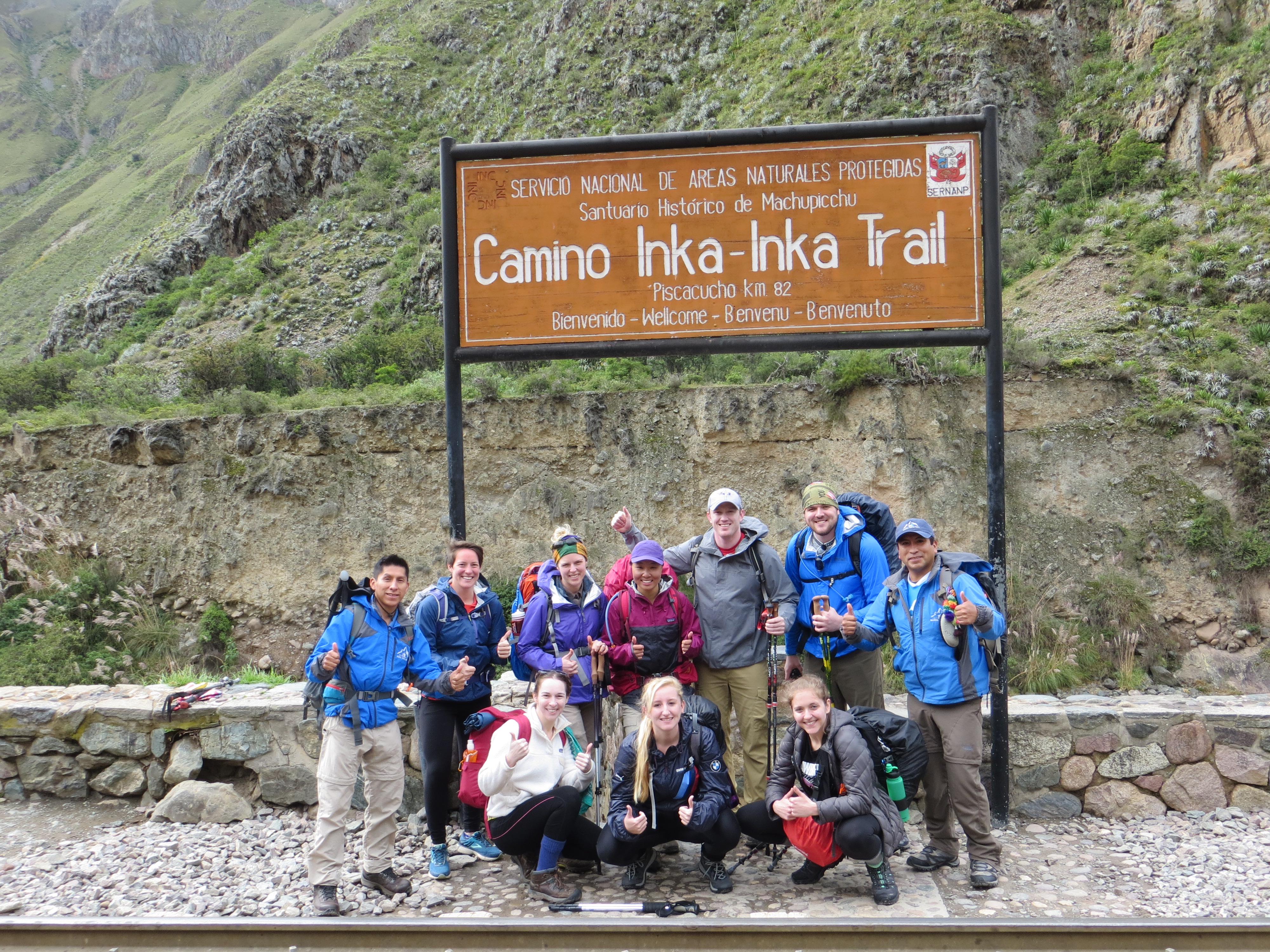
Start of the Inca trail

Now arrived in Cusco, Peru, it was time for the main attraction. Cusco is the entering point for Machu Picchu, which can be done by many different ways. I chose to do a 4 day trek, ending in Machu Picchu. Some parts of the trail is the original inca trail and the only one tourists can trek that leads to Machu Picchu. It starts at Piscacucho km 82, spanning a total of 45km.

Day 1 was a full-day hike, a little taste and practice for the next day. Along the way, the guide would show plants and other small Inca sites. Day 2 was the longest and hardest day, starting off with a treacherous uphill climb to dead woman’s pass just to go back down the other side of the mountain for lunch and continuing to trek until around 5pm. However, the hard part was now over. Day 3 was only a half day of hiking, with some free time after lunch and visiting an Inca site near the camp site. It seemed like the Inca sites visited were getting bigger and bigger, this last one before Machu Picchu especially. I was not prepared at all for the grandeur of what was to come the next day. Day 4, the final day. 3am wake up in the dark, pouring rain only to wait around for 2 hours for the gates to open, guaranteeing us to be one of the first groups to enter. Once in, it is another half hour hike to the sun gate and the full view of Machu Picchu. This came with one final climb up a steep set of stairs, known as the gringo killer. Sadly, I could not get the infamous picture of the sunrise over Machu Picchu because of the clouds completely covering it.

Machu Picchu

The most amazing part of the tour would have to be the porters, each carrying around 25kg bags, running up and down the hills, some wearing a pair of sandals for the hike. In my group, we were 8 with 2 guides and had 16 porters. We all wondered why there was so much to carry and at the 1st meal, we understood. It was one of the most elaborate meals while camping. The table was full of food, almost not enough space to put it all. We all felt so spoiled; it was a glamorizing experience.

Isla del Sol

March 2, 2018

On the border of Peru and Bolivia is Lake Titicaca, a navigable lake at the highest elevation of the world. On the Bolivian side, you access the lake through the town of Copacabana. An hour and a half boat ride will bring you to Isla del Sol or Island of the Sun. The roads are steep there and no cars are polluting the air. I initially planned for a day trip and then bus-ride to my next destination later that day. With bus schedule only allowed an hour on the island, I changed my plan and stayed a night there. During the 1st evening, I hiked around the island, passing a few small Inca ruins along the way. The view from the island was wonderful from all sides albeit a bit windy at the top. Although it was cloudy, the sunset was still beautiful.

Sunset
Sunrise

March 3, 2018

The next day, I walked over to the side of the island where mostly locals live. I sat atop of a rock for the whole morning, watching locals tend to their animals and plant, their daily routines. The calmness and serene environment made a perfect morning. Suddenly, a llama was running around the fields alone and a few steps behind was a local woman. The llama put up quite a chase but in the end, got caught by his owner who didn’t seem too pleased about the situation. Also, because the island has many steep climbs, donkeys, which I had not seen for the duration of my travels, were everywhere. On the docking area, there seemed to be as many donkeys as there were people, bringing products either back from the city or heading to the city.

If more time allowed, it would have been nice to visit Isla de la Luna, another boat ride away. The calm felt on the island is like no other place, especially well appreciated after spending the few days in La Paz.